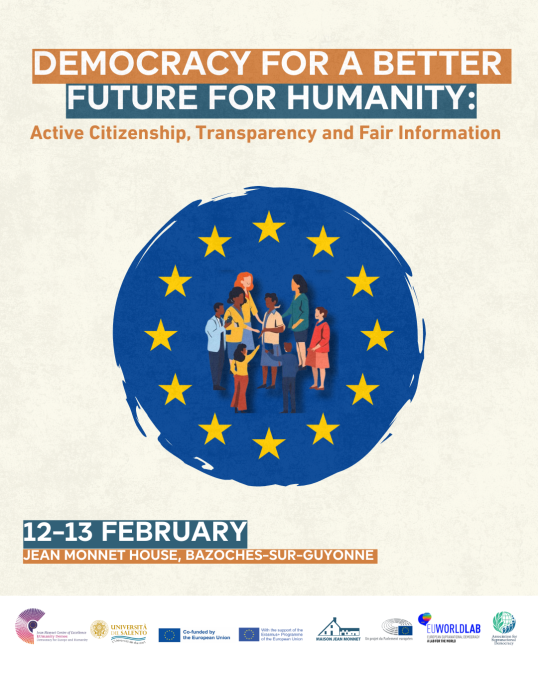
The Jean Monnet House and the Jean Monnet Center of Excellence – University of Salento are co-organising the event “Democracy for a better future of humanity: active citizenship, transparency and fair information”, taking place on 12–13 February at the Jean Monnet House.
Over two days, experts and students will explore one of today’s most pressing challenges: the fight against disinformation. The discussions will focus on the tools European institutions have developed, and those still to come, to address misinformation, lack of transparency and the growing impact of fake news in European democratic life, as well as in the EU’s external relations.
The programme will also include exchanges on media freedom, access to information, digital transparency, and democratic resilience, offering a deeper look at how misinformation shapes public debate and how citizens can better identify and counter it.
Can you spot disinformation? Dive into a fun quiz https://www.europarl.europa.eu/topics/en/article/20250710STO29609/quiz-test-your-knowledge-on-disinformation and a game created by the European Union https://www.voteforturtle.eu/
February 12, 2026
10.00 - Welcoming Remarks
Susanna CAFARO, Full Professor of European Union Law, Università del Salento; Jean Monnet Chair
Mart Grau Segú, Head of service and curator at the Jean Monnet House, European Parliament
10.15 - The Right to Information as a Cornerstone of European Democracy
Focus: access to information, institutional transparency, open data
Objective: explore how access to public information strengthens democratic participation in the EU.
Key discussion points:
- The right to information in the EU: legal frameworks and practical barriers
- Transparency of EU institutions: principles vs. reality
- Open data, FOIA mechanisms and democratic accountability
- Inequalities in access to information across EU Member States
Key question: Can a democracy truly function if information is formally public but practically inaccessible?
Discussants Claudia MORINI, Matteo BASSOLI and Jacopo LILLO
11.15 Media Freedom, Pluralism and Independence in the European Union: from the Media Freedom Act to the Audiovisual Media Services Directive and Democracy Shield
Focus: media independence, ownership concentration, European Media Freedom Act
Objective: examine the role of free and pluralistic media in ensuring fair and reliable information.
Key discussioni points:
- State of media freedom across EU Member States
- Media ownership concentration and risks to pluralism
- The European Media Freedom Act: opportunities and challenges
- Public service media vs. private media: roles and responsibilities
Key question: How can the EU protect media pluralism without undermining editorial freedom?
Discussants Susanna CAFARO, Gilles GANTELET and Francesco SPERA
12.15 Guided Tour of the Monnet House, with Debora RIGHETTI, Public relations assistant at the Jean Monnet House, European Parliament
15.30 Disinformation, Propaganda and Democratic Resilience
Focus: fake news, foreign interference, media literacy
Objective: understand how disinformation threatens democracy and how the EU is responding.
Key discussion points:
- Disinformation as a systemic threat to democratic processes
- The role of social media platforms and digital intermediaries
- EU strategies to counter information manipulation and foreign interference
- Media literacy as a tool for active and informed citizenship
Key question: Does regulating disinformation protect democracy or risk limiting freedom of expression?
Discussants: Polina ZAVERSHINSKAIA, Angela FIORE and Jacob LOLCK expert from the European Parliament Spokesperson’s and Information Integrity Unit (online).
18.00 Brainstorming session
19.00 Monthly Meeting of the Association for Supranational Democracy (online)
February 13, 2026
9.30 Active Citizenship and Institutional Communication in the EU
Focus: citizen engagement, public communication, trust-building
Objective: assess how EU communication strategies can foster participation, trust and inclusion.
Key discussion points:
- How EU institutions communicate: complexity vs. accessibility
- Participatory democracy tools at EU level
- Information, trust and the rise of Euroscepticism
- Young people, digital media and civic engagement
Key question: Is EU communication designed to inform citizens or to persuade them – and where is the line?
Discussants Michele FIORILLO, Gilles GANTELET and Eduardo GIUGLIANO
11.00 Technology, Artificial Intelligence and the Future of Democratic Information
Focus: algorithms, AI, digital regulation
Objective: discuss how emerging technologies are reshaping access to information and democratic debate.
Key discussion points:
- Algorithmic influence on public opinion and information visibility
- AI-generated content, deepfakes and trust in information
- The role of the Digital Services Act and Digital Markets Act
- Transparency and accountability as emerging digital democratic rights
Key question: Can technology strengthen democracy, or is it redistributing informational power?
Discussants Renzo CONSOLI (online), Francesco SPERA and Monica SPATTI (online)
12.00 Networking Walk: on Jean Monnet’s Steps, with Mart Grau Segú
LAB: DRAFTING OF AN EUROPEAN CITIZENS’ INITIATIVE
15.00 Lab on a European Citizens’ Initiative on How to Improve Citizens’ Access to Information Amending the Audiovisual Media Services Directive
Facilitators: Susanna CAfaro – Claudia MORINI – Francesco SPERA – Michele FIORILLO
- désinformation | démocratie
- jeudi 12 février 2026, 10 h 00 - vendredi 13 février 2026, 16 h 00 (CET)
- Public
- Adultes
- Type d’événement
- Débat
Informations pratiques
- Quand
- jeudi 12 février 2026, 10 h 00 - vendredi 13 février 2026, 16 h 00 (CET)
- Langues
- italien
Autres événements
- Bruxelles, Belgique
- Public
- Adultes
- Familles
- Écoles
- Jeunes adultes
- Type d’événement
- Visites
- Magny-les-Hameaux, France
- Public
- Adultes
- Familles
- Écoles
- Jeunes adultes
- Type d’événement
- Expositions
- Jouars Pontchartrain, France
- Public
- Adultes
- Familles
- Écoles
- Jeunes adultes
- Type d’événement
- Expositions